
● Bio-Plant Engineering
Our laboratory’s Bio-Plant Engineering research focuses on the design, optimization, and sustainability enhancement of biomanufacturing plants. We quantitatively analyze material flows in bioprocesses and develop process strategies to improve economic performance while minimizing energy and resource consumption.
To achieve this, we employ process analysis and optimization approaches that integrate biotechnology principles, process simulation, and empirical data, with the goal of enabling environmentally friendly and sustainable production of bio-based products. Representative studies include improving the thermal efficiency of amino acid production processes and assessing their environmental impacts.
Danbee Park, Hyunwoo Kim, Sangmin Park, Jina Lee, Dong Hun Kwak, Kwang Soo Shin, Yongchan Lee, Hyaekyoung Kim, Jun-Woo Kim*, Wangyun Won*, Comprehensive life cycle assessment of powder- vs. granule-form L-lysine production: Evaluating climate impact and sustainability, Chemical Engineering Journal, 2025, 513, 162972.
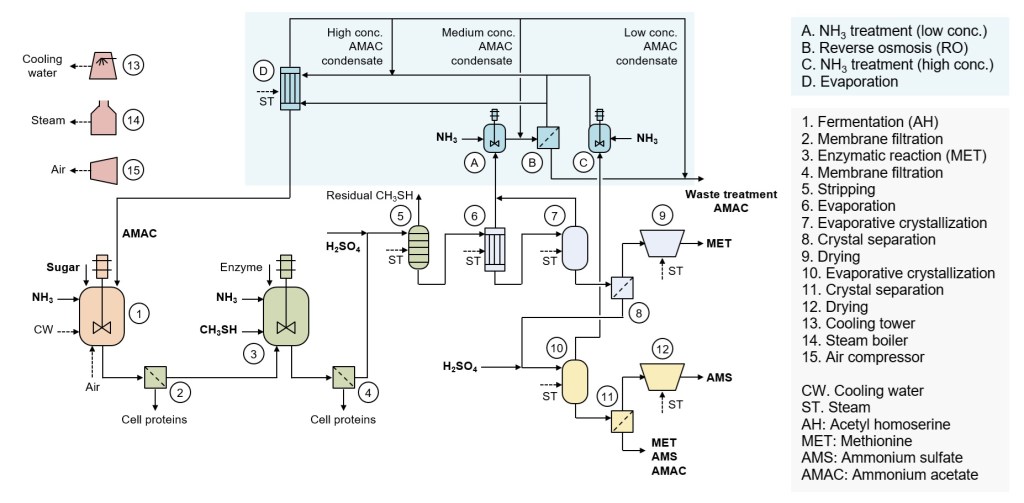
Woo Hyung Park, Chan Hun Park, Jina Lee, Ik-Jong Choi, Dong-Hyun Kim, Jun-Woo Kim*, Comparative analysis of multi-effect evaporators in ammonium acetate concentration process for L-methionine production, Separation and Purification Technology, 2025, 354, 3, 128938.
Hyunwoo Kim, Behnam Saremi, Sangmin Park, Mooyoung Jung, Yeohong Yun, Juyeon Son, Jina Lee, Jun-Woo Kim*, Wangyun Won*, Comparative life-cycle assessment for the sustainable production of bio-based L-methionine, Journal of Cleaner Production, 2024, 462, 142700.
● Digital Twin & AI-Based Modeling
Our Digital Twin and AI-Based Modeling research focuses on developing digital twins of real-world processes and manufacturing systems to enable real-time state estimation, anomaly detection, performance prediction, and optimal decision-making. Digital twin models are designed as virtual representations closely connected to physical systems, allowing process behavior to be interpreted using operational data and sensor signals.
By integrating artificial intelligence and data-driven modeling techniques, we aim to rapidly predict process responses under abnormal operating conditions and automate fault diagnosis. These approaches provide methodologies for reducing operational risks in complex bioprocesses and large-scale industrial systems while simultaneously improving productivity and product quality.
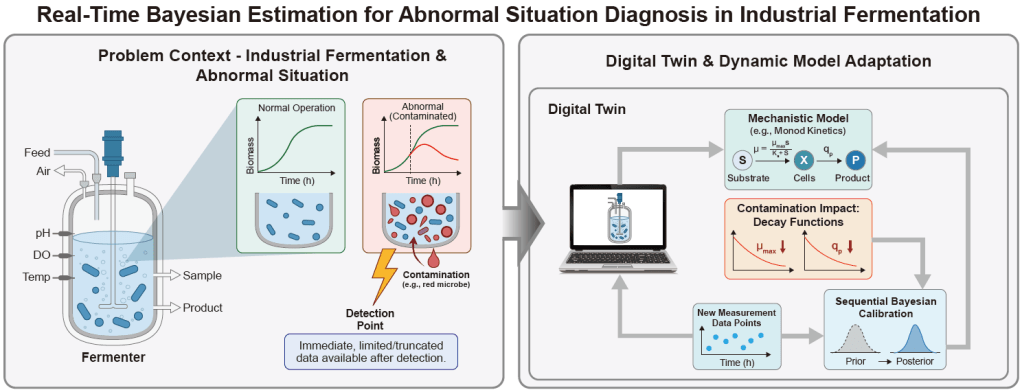
Wangsoo Kim, Jaeho Jung, Jaeik Kim, Chanhun Park, Joon Young Jung, Wonseok Lee, Jay Yun, Jung-Oh Ahn*, Sangmin Park*, Jun-Woo Kim*, Effect of Data Availability on In-Line Adaptation of Fermentation Mechanistic Models Under Abnormal Conditions, Chemical Engineering Journal Advances, 2026, 26, 101157.
Jun-Woo Kim*, Hyunwoo Kim, Gilsang Joo, Jeong-Geol Na, Wangyun Won*, Novel shortcut estimation method for economics of industrial amino-acid process, New Biotechnology, 2026, 93, 280.

